Definition
Ontology refers to the assumptions a researcher makes about the nature of reality and what exists independently of human perception. In research methodology, ontology addresses questions about whether social phenomena are objective entities that exist independently of individuals or whether they are constructed through human interpretation and interaction.
In simple terms, ontology is concerned with what is real in the context of a research study.
As Crotty explains:
“Ontology is concerned with what is, with the nature of existence, with the structure of reality as such.”
— Crotty (1998, p. 10)
Key Characteristics
- Focuses on assumptions about the nature of reality
- Shapes how research problems are defined
- Often implicit rather than explicitly stated
- Influences the choice of research methods
- Forms the foundation of a research paradigm
How It Is Used in Research
Ontological assumptions guide how researchers conceptualize organizations, individuals, and and social processes. These assumptions influence how research questions are framed, what is considered valid data, and how findings are interpreted.
In management research, ontology affects whether organizations are studied as objective structures such as systems, processes, and measurable variables or as socially constructed realities shaped by meanings, beliefs, and interactions.
Example (Management Research)
Consider a researcher studying organizational culture.
If the researcher assumes that organizational culture exists as an objective reality, such as a set of shared values that can be measured consistently across employees, this reflects a realist ontology. The researcher may use surveys with standardized scales to quantify cultural dimensions.
Alternatively, if the researcher assumes that organizational culture is created through ongoing interactions, conversations, and shared interpretations among employees, this reflects a constructivist ontology. In this case, the researcher may use interviews or observations to explore how employees describe and experience culture.
In both cases, the research topic remains the same, but the underlying ontological assumption leads to different research designs and methodological choices.
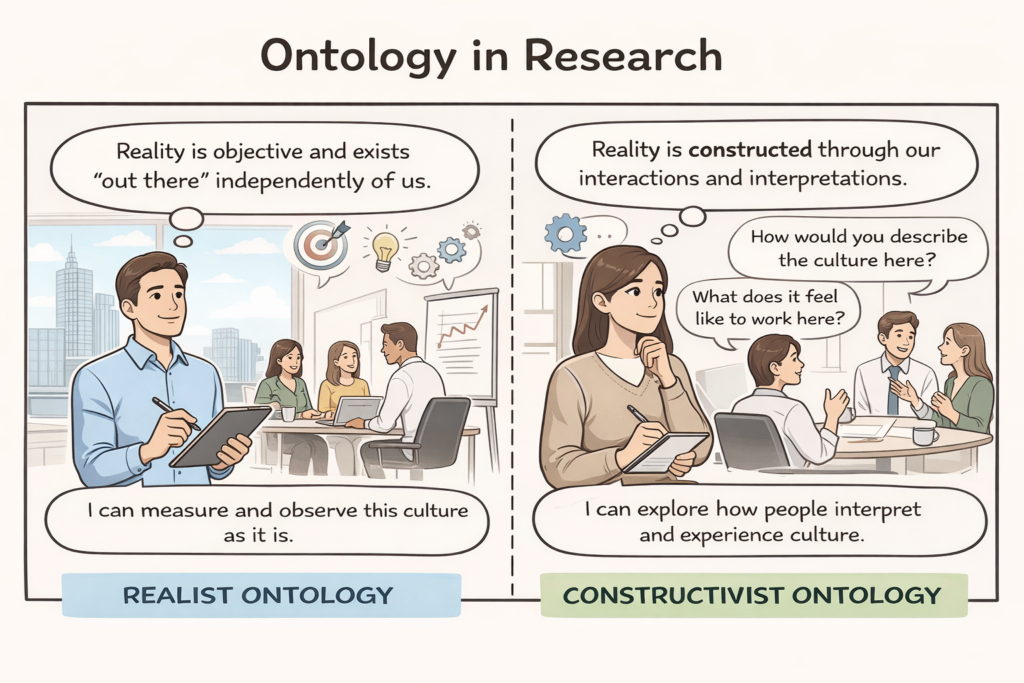
Figure 1. Contrasting ontological assumptions in management research: realist and constructivist perspectives.
Common Confusions
Ontology is often confused with epistemology. While ontology concerns the nature of reality, epistemology concerns how knowledge about that reality is generated and validated.
Another common misunderstanding is assuming that ontology is purely philosophical and disconnected from empirical research. In practice, ontological assumptions directly shape research design, data collection, and interpretation.
Why It Matters
Unexamined ontological assumptions can lead to misalignment between research questions, methods, and conclusions. When ontology is unclear, research designs may appear inconsistent or theoretically weak.
Being explicit about ontological assumptions improves methodological rigor and helps readers understand the logical foundations of a research study.
Reference
Crotty, M. (1998). The Foundations of Social Research: Meaning and Perspective in the Research Process. London: Sage Publications.
To further contextualize ontology in research, it is useful to consider epistemology, which addresses how knowledge about reality is generated and justified. Readers interested in how assumptions about reality relate to claims of knowledge may find the post “Epistemology in Research: A Clear Explanation” helpful.
Leave a Reply to Methodology vs Research Strategy: Key Differences Explained Cancel reply