In research writing, the term research methods is often used loosely to describe any technique used to collect or analyse data. However, within academic research, particularly in management and social sciences, research methods have a more specific and defined role. Understanding what research methods are, and how they differ from concepts such as methodology, research strategy, and research design, is essential for producing clear and rigorous research.
What Are Research Methods?
Research methods refer to the specific techniques and procedures used to collect, generate, and analyse data in a research study. They represent the most operational level of the research process and describe what the researcher actually does to produce empirical evidence.
Methods answer practical questions such as:
- How will data be collected?
- What tools or instruments will be used?
- How will the data be analysed?
Unlike methodology, which explains the logic and justification behind research choices, research methods focus on execution. They translate research design into concrete actions.
Research Methods Within the Research Process
Research methods sit at the final stage of the research planning hierarchy.
- Ontology addresses assumptions about reality
- Epistemology addresses assumptions about knowledge
- Methodology provides the guiding research logic
- Research strategy outlines the overall approach
- Research design structures the study
- Research methods implement the design
In this sense, research methods are not chosen in isolation. They must be consistent with the broader methodological framework and appropriate for the research design adopted.
Common Types of Research Methods
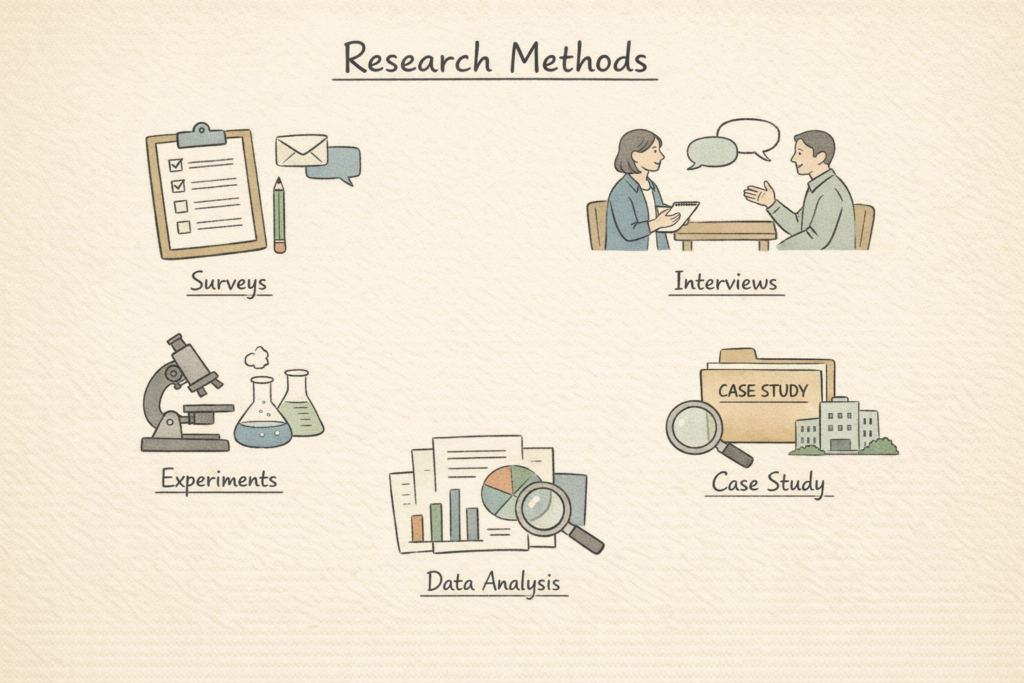
Research methods are often categorised based on the type of data they generate and how that data is analysed. Common methods in management and social science research include:
- Interviews, used to explore experiences, perceptions, and meanings in depth
- Surveys and questionnaires, used to collect standardized data from larger samples
- Observations, used to examine behaviour and practices in natural or controlled settings
- Document and archival analysis, used to analyse existing texts, records, or reports
- Experiments, used to examine causal relationships under controlled conditions
Each method serves a different purpose and is suited to different research questions. The choice of method should be guided by what the researcher seeks to understand, explain, or measure.
An Example from Management Research
Consider a study examining leadership practices in project teams.
If the research design is exploratory and aims to understand how leadership is experienced by team members, the researcher may choose semi-structured interviews as the primary research method. This method allows participants to describe their experiences in their own terms while still maintaining focus on key themes.
Alternatively, if the research aims to measure the relationship between leadership style and team performance across multiple organizations, a survey method may be more appropriate. In this case, standardized questionnaires can generate comparable data suitable for statistical analysis.
In both scenarios, the research methods are selected because they align with the research design and the type of insight sought.
Why Research Methods Matter
The credibility of a research study depends heavily on the appropriateness and transparency of its methods. Poorly chosen or inadequately described methods can undermine otherwise well-conceived research.
Clear articulation of research methods allows readers to:
- understand how findings were produced,
- assess the quality and reliability of the data, and
- evaluate whether conclusions are supported by evidence.
From an academic standpoint, explicitly describing research methods is also essential for replication and critical review, both of which are central to scholarly inquiry.
Research Methods and Academic Rigor
Research rigor is not achieved through methods alone, but through the fit between methods, design, and methodology. Even technically sound methods can produce weak research if they are misaligned with the research question or philosophical assumptions of the study.
For this reason, academic writing requires researchers to justify not only what methods were used, but why those methods were appropriate. This justification links methods back to earlier decisions in the research process and reinforces the coherence of the study.
Conclusion
Research methods are the practical tools through which research is carried out. They operationalize research design and enable researchers to generate and analyse data in a systematic manner. Understanding research methods and their place within the broader research framework is essential for conducting and evaluating rigorous academic research.
To understand how research methods are selected and structured within a study, readers may find the post “Research Design in Research: A Clear Explanation” helpful, as it clarifies how research methods emerge from earlier design decisions.
Leave a Reply to Survey Research as a Quantitative Method Cancel reply